
How to Scale Pressure Vessel Production Without Compromising Quality
Scaling pressure vessel production sounds straightforward. If demand increases, increase capacity and manufacture more.
In reality, it isn’t that simple.
When pressure vessels are being manufactured for healthcare, energy and other regulated industries, increasing output cannot come at the expense of consistency, compliance or quality. Producing one vessel successfully is one challenge. Producing hundreds or thousands while maintaining the required standards is another entirely.
The real question, then, isn’t simply how to manufacture more. It’s how to make the entire manufacturing process repeatable enough to scale.
Scaling Starts With Repeatability, Not Speed
Greater production doesn’t necessarily begin with making individual operations faster.
Before increasing output, manufacturers need a stable process that can be repeated consistently. Material preparation, forming, fit-up, welding, inspection, testing and documentation all need to work together.
If a process depends on constant intervention or troubleshooting, those problems don’t disappear when volumes increase. They tend to become more significant.
That’s why repeatability matters. Establishing controlled processes before increasing production helps create a stronger foundation for growth.
Often, the fastest route to greater output isn’t making every stage faster. It’s removing the reasons production slows down in the first place.
Find the Bottlenecks Before They Find You
Increasing capacity in one area doesn’t necessarily increase the capacity of the whole operation.
More welding capacity, for example, provides limited benefit if material preparation cannot keep pace. Likewise, increasing fabrication output can simply move the bottleneck further down the line if inspection and testing become overwhelmed.
Successful high-volume pressure vessel manufacturing therefore requires a view of the entire production route.
Materials need to arrive when required. Components need to move efficiently through preparation and forming. Welding capability needs to match demand, while inspection, testing and documentation must keep pace with production.
People matter too. Equipment can increase capacity, but experienced welders, engineers and quality personnel are still needed to maintain control as volumes grow.
The objective is balanced capacity rather than simply more capacity.
Standardise What You Can – Control What You Can’t
Pressure vessel manufacturing is rarely a simple production-line exercise. Materials, geometries, customer specifications and operating requirements can all influence how a vessel needs to be manufactured.
That doesn’t mean repeat production cannot be standardised.
Established workflows, controlled welding procedures, consistent production setups and planned inspection stages can all help reduce unnecessary variation.
The aim isn’t to force every project into the same manufacturing process. It’s to create controlled repeatability wherever the product and its requirements allow.
This becomes particularly important as production increases. Small inefficiencies or inconsistencies that are manageable at low volumes can become significant when repeated across hundreds of units.
Good manufacturing engineering addresses those issues before they have the opportunity to multiply.
Automation Works Best When Engineering Comes First
Automation can play an important role in scaling pressure vessel production, particularly where repeatable geometries and higher volumes make robotic or semi-automated processes suitable.
But automation isn’t simply a matter of replacing a manual operation with a machine.
Components still need to be properly prepared. Fit-up needs to be consistent. Welding procedures need to be established and controlled. The manufacturing process itself needs to be suitable for repeatable automated production.
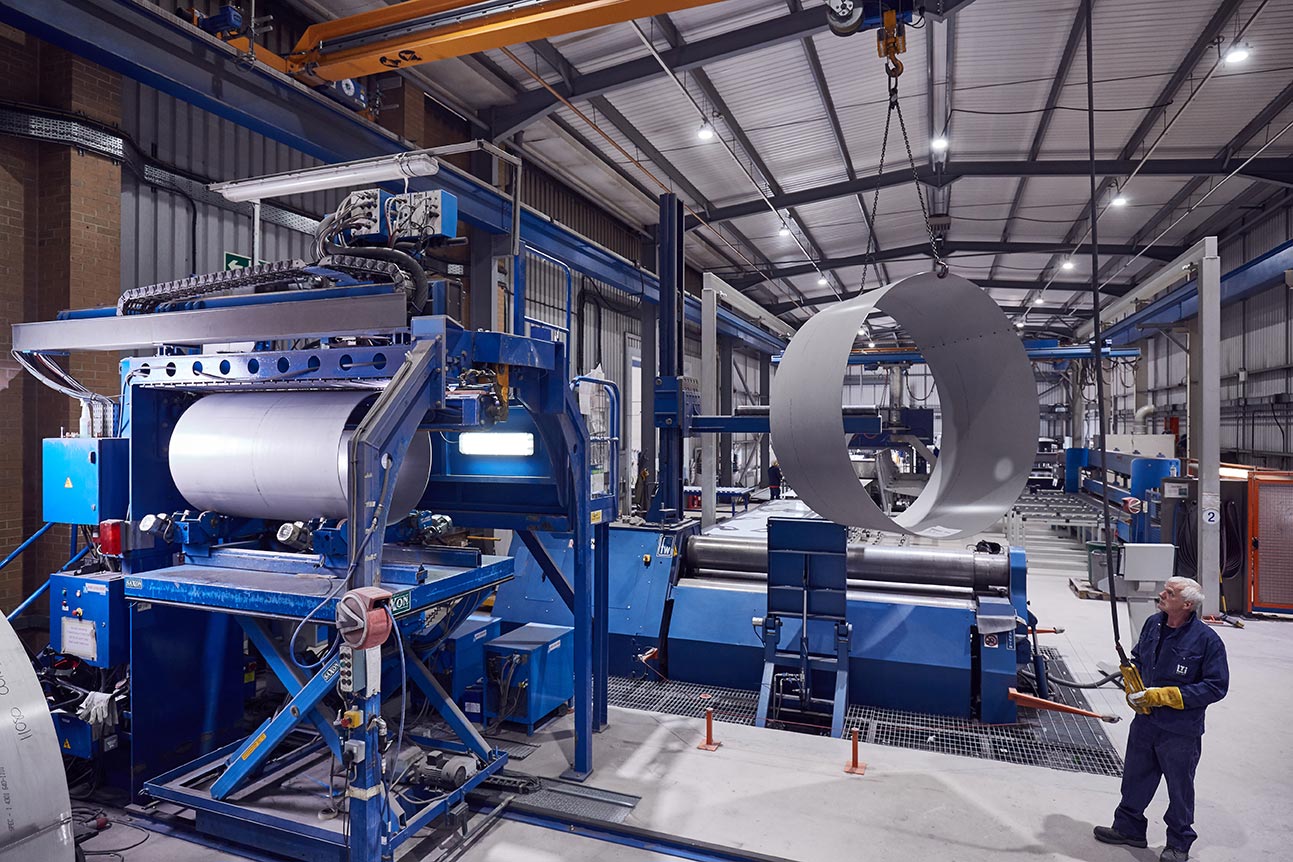
At LTi Metaltech, advanced robotic and semi-automated systems operate alongside an experienced team of coded welders. This combination provides the flexibility to support technically complex fabrication while also delivering the consistency required for scalable production.
Automation doesn’t remove the need for manufacturing expertise. It makes good manufacturing engineering more repeatable.
Skilled People Become More Important, Not Less
As automation increases, skilled people remain fundamental to the process.
Experienced coded welders understand how materials and welding processes behave in real production environments. Engineers help establish effective manufacturing routes, while quality and inspection personnel ensure requirements continue to be met as output increases.
This combination of people and technology is particularly important in high-integrity fabrication.
LTi Metaltech has one of the UK’s largest teams of coded welders, working alongside advanced manufacturing technology at its Oxfordshire facility. Rather than treating manual expertise and automation as competing approaches, the two can be used where each adds the greatest value.
Scale doesn’t come from people or automation alone. It comes from using both effectively.
Quality Can’t Become the Bottleneck
One of the risks of increasing production is treating quality control as something that happens once fabrication is complete.
If problems are only identified during final inspection, greater output can mean greater rework, additional delays and unnecessary cost.
Quality therefore needs to move with production.
Controlled welding procedures, traceability and appropriate inspection throughout manufacture can help identify issues earlier. Testing can then provide the verification required for the particular vessel and application.
LTi Metaltech provides in-house and third-party testing, with methods including radiographic inspection, helium leak detection and hydrostatic testing tailored to individual project requirements.
Its operations are certified to ISO 9001, ISO 14001 and ISO 45001, and the company works in accordance with recognised international codes and standards including ASME, PD 5500, AD 2000-Merkblatt, ISO 3834, EN 13445 and ISO 1090.
For scalable production, quality cannot simply sit at the end waiting for manufacturing to catch up. It needs to be part of the process from the beginning.
What Repeat Production Looks Like in Practice
Experience matters when moving from individual builds to sustained production.
LTi Metaltech has manufactured more than 15,000 cryogenic pressure vessel sets for MRI systems installed in hospitals worldwide. The company also has a long-standing relationship with Siemens Healthineers MR Magnet Technology, supporting the manufacture of precision-engineered cryogenic pressure vessels for MRI systems.
Manufacturing pressure equipment for healthcare applications at this scale highlights an important point about repeat production: consistency needs to be maintained not just from one vessel to the next, but across long-term manufacturing programmes.
That requires more than fabrication capacity. It requires established processes, skilled people and a manufacturing environment built around repeatable quality.
Scale the Supply Chain, Not Just the Factory
A production programme extends beyond the factory floor.
Higher volumes place greater demands on materials, suppliers, specialist services, inspection resources, scheduling and logistics. If those elements cannot scale alongside manufacturing, they can quickly become constraints.
Supply chain coordination is therefore an important part of increasing pressure vessel production.
The manufacturer needs to understand what the programme will require not only today, but as demand develops. Identifying potential constraints early gives both manufacturer and customer more opportunity to address them before they begin affecting delivery.
For OEMs in particular, this wider view can be just as important as the fabrication process itself.
Think About Volume Before Volume Arrives
The best time to consider scalability is before production needs to increase.
Can the existing design be manufactured efficiently and repeatedly? Which processes could become constrained as quantities rise? Where could automation add value? Can inspection and testing keep pace? Is the supply chain capable of supporting sustained production?
Answering these questions early can help create a more dependable route from initial manufacture to higher-volume production.
It also gives engineering and manufacturing teams the opportunity to improve repeatability before they are working against growing order volumes and tighter production schedules.
Scaling the Process, Not Just the Output
Scaling pressure vessel production isn’t simply about making more vessels.
It means developing a manufacturing system in which engineering, skilled people, automation, quality control, testing and supply chain coordination can all support greater output without losing the standards the application demands.
With more than 40 years of pressure vessel expertise, advanced robotic and semi-automated manufacturing capability, one of the UK’s largest teams of coded welders and experience manufacturing more than 15,000 cryogenic pressure vessel sets, LTi Metaltech understands what sustained high-integrity production requires.
If you’re planning to increase pressure vessel production or need a manufacturing partner capable of supporting long-term, high-volume requirements, speak to the LTi Metaltech team about building a reliable route to scale.