
From Flat Sheet to Finished Vessel: The Role of Advanced Metal Forming in Pressure Vessel Manufacturing
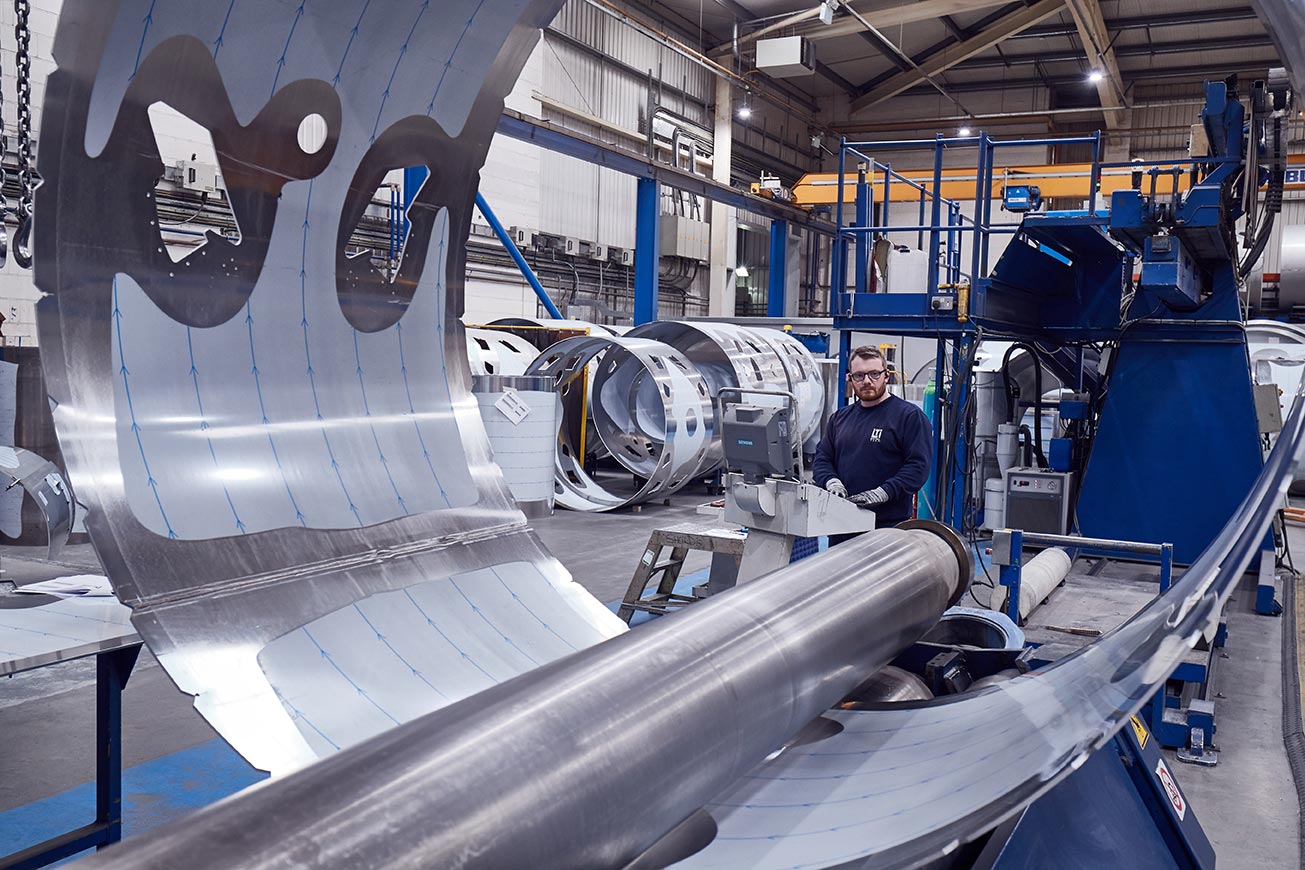
Every pressure vessel starts somewhere.
Before welding, inspection and testing, there is material that needs to be prepared, shaped and brought together to create the required structure. By the time the finished vessel leaves the factory, it can look a long way removed from the flat sheet or plate that entered it.
But those early stages matter.
Metal forming creates the geometry that subsequent fabrication processes depend upon. Get that foundation right and manufacturers have a more consistent starting point for fit-up, welding and assembly. When pressure vessels are being produced repeatedly for demanding applications, that consistency becomes even more important.
What Is Metal Forming?
Metal forming is the process of shaping prepared material into the geometries needed for fabrication.
In pressure vessel manufacturing, that can include creating cylindrical and curved sections that will later be assembled and welded into the finished structure.
It sounds relatively simple, but forming isn’t just a matter of bending metal until it looks right. Dimensions, geometry and repeatability all need to be considered because each formed component has to work with the manufacturing stages that follow.
The aim is to produce components that meet the requirements of the design while providing a controlled starting point for subsequent fabrication.
In other words, forming is one stage in a much bigger manufacturing process – and decisions made here can have an impact further down the line.
Why Forming Accuracy Matters
A pressure vessel is created through a sequence of connected operations. That means variation introduced during one stage can create additional challenges during another.
Accurately formed components can support more consistent alignment and fit-up when sections are brought together for fabrication. This, in turn, provides a better foundation for controlled welding.
Where geometry varies, additional adjustment may be needed before fabrication can continue.
That matters on individual vessels, but it becomes particularly important when production volumes increase. A small inconsistency repeated across a long production run can quickly become a much larger manufacturing issue.
Accurate forming therefore isn’t simply about achieving the correct shape. It helps establish the consistency needed throughout the rest of the pressure vessel manufacturing process.
Understanding How Materials Behave
Not every material behaves in exactly the same way during manufacturing.
Material grade, thickness, required geometry and the overall specification can all influence how a component needs to be prepared and formed.
This is where manufacturing experience becomes important.
The process needs to account for both the required finished geometry and the material being used to create it. That requires an understanding of how preparation and forming fit into the wider fabrication route rather than treating them as isolated operations.
LTi Metaltech has experience working across multiple metals for demanding pressure vessel and fabrication applications. Combining material knowledge with practical manufacturing expertise helps establish an appropriate route from prepared material through to finished component.
Precision Welding Starts Before the Welding Arc
Welding naturally receives a great deal of attention in pressure vessel manufacturing – and for good reason.
But a high-integrity weld doesn’t exist in isolation.
Before welding begins, components need to have been prepared, formed and brought together correctly. The geometry presented to the welder or automated welding system is the result of everything that has happened beforehand.
Consistent formed components can help create more controlled fit-up and alignment, providing a repeatable foundation for the welding operation that follows.
That is why material preparation, forming and precision welding should be considered as connected parts of the same manufacturing process.
At LTi Metaltech, forming sits alongside material preparation, precision welding, high-integrity fabrication and engineering support. Looking at these stages together helps create a more integrated route through production.
Repeatability Matters Even More at Scale
Producing one component to the required standard is one challenge. Producing the same result repeatedly across a sustained manufacturing programme introduces another.
As volumes increase, repeatability becomes increasingly important.
Processes that rely on continual adjustment can restrict production and create unnecessary variation. More consistent material preparation, forming and fit-up can instead help establish a manufacturing process that is easier to repeat.
This is particularly relevant to high-volume pressure vessel manufacturing, where quality needs to be maintained from one vessel to the next.
LTi Metaltech combines skilled manufacturing teams with advanced robotic and semi-automated systems to support both technically complex fabrication and repeatable high-volume production.
The objective isn’t simply to make components faster. It’s to establish manufacturing processes capable of delivering the required result consistently.
Where Automation Fits Into the Process
Advanced manufacturing technology can play an important role in achieving that consistency, but automation isn’t a substitute for good manufacturing engineering.
For robotic and semi-automated systems to operate effectively, the surrounding manufacturing process needs to be controlled. Component preparation, fit-up and established welding procedures all contribute to creating the conditions for repeatable production.
Skilled people remain central too.
LTi Metaltech has one of the UK’s largest teams of coded welders working alongside advanced robotic and semi-automated manufacturing systems. This combination allows technology and practical fabrication expertise to be applied where each is most appropriate.
Automation can help make a well-engineered process more repeatable. The engineering still has to come first.
Quality Doesn’t Begin at Final Inspection
Pressure vessels for demanding and regulated industries may be subject to extensive inspection and testing before they are approved for their intended application.
However, testing isn’t where quality begins.
Quality needs to be considered from the earliest stages of manufacturing – through material preparation and forming, into fit-up and welding, and finally through inspection and verification.
LTi Metaltech provides in-house and third-party testing, with methods including radiographic inspection, helium leak detection and hydrostatic testing selected according to individual project requirements.
The company also operates to ISO 9001, ISO 14001 and ISO 45001 and works in accordance with recognised pressure vessel and fabrication codes and standards.
These controls provide assurance around the finished product, but they are most effective when supported by a manufacturing process designed around quality from the outset.
Testing verifies the result. Controlled manufacturing helps create it.
From Flat Material to MRI Pressure Vessels
The importance of repeatability becomes particularly clear when pressure vessels are manufactured over long-term production programmes.
LTi Metaltech has manufactured more than 15,000 cryogenic pressure vessel sets for MRI systems installed in hospitals around the world.
Reaching that level of repeat production requires more than completing the final welding operation successfully.
The manufacturing sequence as a whole needs to work together, from material preparation and forming through fabrication, welding, inspection and testing.
LTi Metaltech’s long-standing work manufacturing precision-engineered cryogenic pressure vessels for MRI applications provides a practical example of how high-integrity fabrication and repeatable production come together.
It also demonstrates why the earliest manufacturing stages deserve attention. When components are being produced repeatedly, consistency at the beginning supports consistency throughout the process.
Why Integrated Manufacturing Matters
It can be tempting to think about cutting, forming, welding and testing as separate manufacturing services.
In practice, the stages are closely connected.
The condition and geometry of a component leaving one process affects what the next process has to work with. Considering those relationships early can help establish a more coherent manufacturing route.
For OEMs and organisations operating in sectors such as healthcare, renewable energy and nuclear fusion, the requirement isn’t simply for somebody who can form metal or make a weld.
The finished pressure vessel needs to meet the requirements of its intended application, and every manufacturing stage has a role in achieving that.
An integrated approach helps keep those stages focused on the same outcome.
The Finished Vessel Starts With the First Manufacturing Step
By the time a pressure vessel has been assembled, welded, inspected and tested, the flat material it started from may be difficult to recognise.
But the quality of those early manufacturing stages remains important all the way through to the finished vessel.
Careful material preparation and forming establish the geometry for fabrication. Consistent fit-up supports controlled welding. Inspection and testing then provide the required verification before the vessel enters service.
With more than 40 years of pressure vessel expertise, advanced robotic and semi-automated manufacturing capability and one of the UK’s largest teams of coded welders, LTi Metaltech supports high-integrity pressure vessel manufacturing for demanding and regulated applications.
If you’re planning a high-volume pressure vessel programme or require precision fabrication for a technically demanding application, speak to LTi Metaltech about developing a manufacturing route from material preparation through to finished production.