
Beyond the Drawing: Turning Complex Engineering Requirements into Practical Manufacturing Solutions
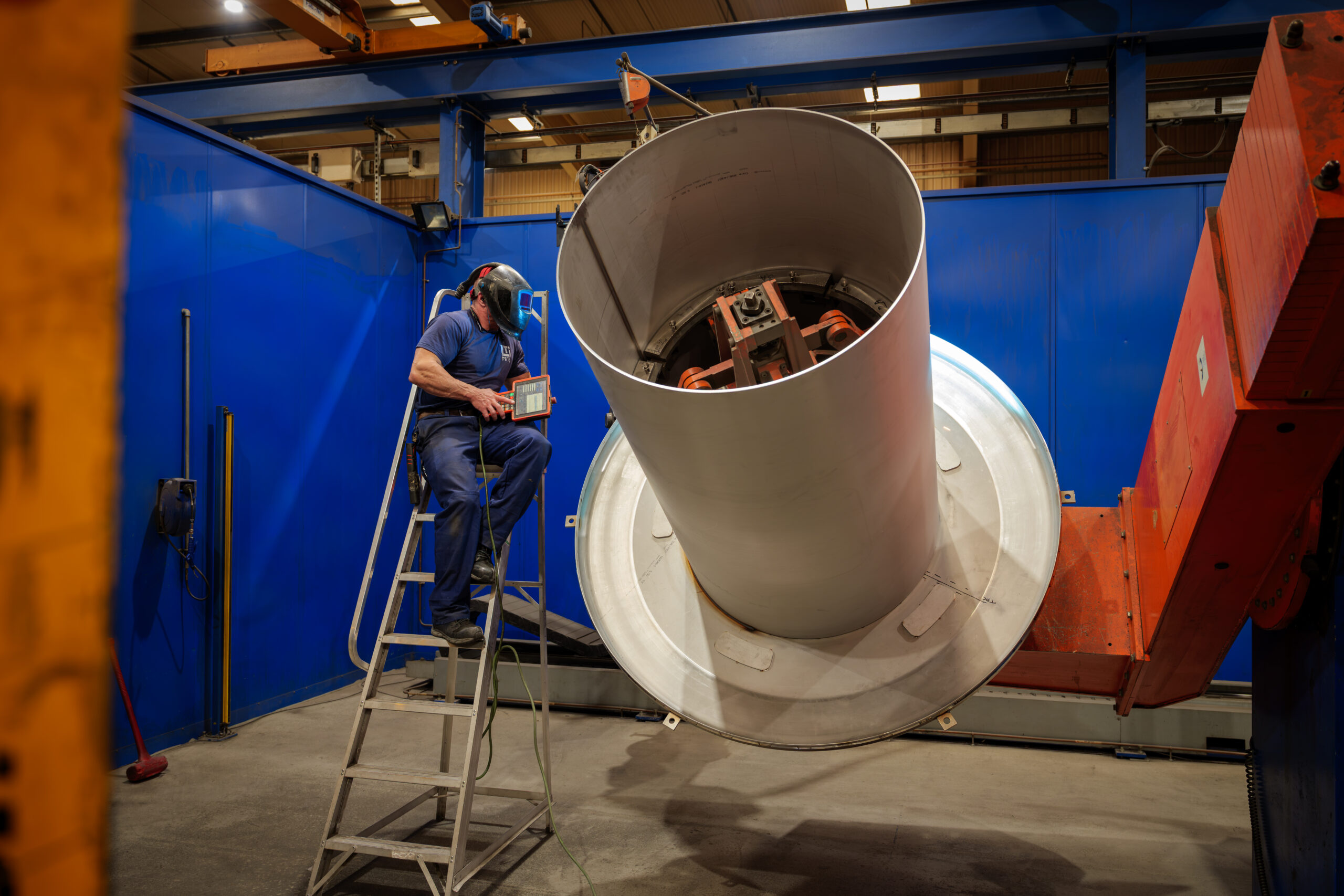
A drawing might specify a tolerance down to a fraction of a millimetre. What it won’t necessarily tell you is how to maintain that tolerance through forming, welding and assembly – or how to achieve the same result consistently across hundreds of components.
That’s where manufacturing engineering comes in.
For pressure vessels and other high-integrity fabricated components, meeting the specification involves much more than following a drawing. Materials, geometry, welding requirements, inspection and production volumes all influence how the finished equipment needs to be manufactured.
A design might be technically sound, but turning it into a reliable production process is a challenge in its own right.
And when the equipment is destined for demanding applications in healthcare, renewable energy or nuclear fusion, getting that process right matters.
From Specification to Manufacturing Reality
An engineering drawing establishes what needs to be achieved. The manufacturer’s job is to work out how to achieve it.
That involves looking beyond individual dimensions and understanding how the requirements affect the manufacturing process as a whole.
A particular material grade might influence how a component is prepared, formed and welded. A complex geometry could affect assembly. Tight tolerances may require additional consideration during forming and fit-up.
Then there are the requirements that aren’t always obvious from looking at the finished component, such as welding procedures, inspection access, testing and traceability.
Each needs to be accounted for when developing the manufacturing route.
This is where early collaboration between engineering and manufacturing teams becomes valuable. Practical fabrication knowledge can help identify potential constraints before production begins, giving everyone a clearer understanding of what the design will require in the workshop.
The goal isn’t to change a specification simply because it’s challenging. It’s to find a practical, controlled way of meeting it.
Where Small Variations Become Bigger Problems
Consider a pressure vessel component with a curved section that needs to meet tight dimensional tolerances.
On the drawing, the required geometry is clearly defined. But the manufacturing team still needs to establish how the material will be formed, how the finished section will be checked and how it will fit with the components around it.
Now imagine a small amount of variation occurring during forming.
That variation could affect alignment during assembly, which may then influence fit-up and welding. What began as a relatively minor dimensional difference has now introduced additional work further along the manufacturing process.
For a single component, an adjustment might be manageable.
But what happens when the same component needs to be manufactured hundreds of times?
Repeated adjustments can become a significant production constraint. They also make it harder to establish the consistency needed for high-volume pressure vessel manufacturing.
This is a hypothetical example, but it illustrates a common manufacturing principle: the earlier variation is understood and controlled, the less opportunity it has to affect subsequent operations.
Rather than relying on corrections during assembly, manufacturers can consider preparation, forming and dimensional controls when establishing the production process.
That’s how manufacturing engineering turns a technical requirement into something that can be achieved repeatedly.
Why the Manufacturing Sequence Matters
Even when every individual operation is technically achievable, the order in which those operations take place can make a difference.
Material preparation affects forming. Forming influences fit-up. Fit-up provides the starting point for welding. And welding and assembly need to accommodate whatever inspection and testing the finished equipment requires.
Take inspection access as an example.
If a particular weld needs examination before surrounding components are installed, that requirement needs to influence the assembly sequence. Discovering it after fabrication has progressed could create an avoidable complication.
The same applies to dimensional checks, material preparation and other manufacturing requirements.
At LTi Metaltech, our capabilities cover material preparation, forming, precision welding, high-integrity fabrication, engineering support and testing.
Considering these activities as connected stages allows the manufacturing route to be developed around the finished component’s requirements.
For customers, this means the discussion goes beyond whether an individual operation can be completed. It considers how the complete manufacturing process will work.
Making the Process Work at Scale
Successfully manufacturing one component doesn’t automatically mean the same approach will work across a long production programme.
A one-off build may involve individual adjustments and specialist problem-solving. Those approaches can be appropriate for complex bespoke work, but they aren’t necessarily the best foundation for repeat production.
At higher volumes, consistency becomes essential.
Material preparation needs to produce reliable starting conditions. Forming and fit-up must remain controlled. Welding procedures need to be suitable for repeat manufacture, while inspection and testing must be considered alongside production capacity.
The challenge is to establish a process that can consistently achieve the required standard without depending on repeated intervention.
For OEMs, this raises an important question early in the project: can the proposed manufacturing approach deliver the required quality at the intended production volume?
Answering that question before production increases can help identify constraints and opportunities to improve repeatability.
It also changes how manufacturers think about efficiency. Making an individual operation faster has limited value if the next stage cannot keep pace or requires additional work to correct variation.
A reliable production process needs to work as a whole.
Where Skilled People and Automation Add Value
Advanced manufacturing technology can make an important contribution to repeatability, particularly where production volumes and component requirements make automated processes appropriate.
But automation isn’t a shortcut around manufacturing engineering.
Robotic and semi-automated systems still depend on consistent component preparation, controlled fit-up and established welding procedures. If the underlying process isn’t suitable, repeating it automatically won’t solve the problem.
At LTi Metaltech, we combine advanced robotic and semi-automated manufacturing systems with one of the UK’s largest teams of coded welders.
That combination supports both technically complex fabrication and repeatable high-volume production.
Skilled welders and engineers bring the practical knowledge needed to understand materials, establish suitable manufacturing approaches and address demanding fabrication requirements.
Advanced systems can then support consistency where automation is appropriate.
Automation can repeat a process. Engineering expertise determines whether it’s the right process to repeat.
For high-integrity pressure vessel manufacturing, both have an important role.
Quality Has to Be Built Into the Process
A practical manufacturing solution must do more than produce a component with the correct dimensions.
It also needs to satisfy the quality, inspection and testing requirements of the intended application.
For pressure vessels used in regulated industries, those requirements can influence manufacturing decisions from the beginning.
Welding procedures, material traceability, inspection access and documentation all need appropriate consideration. Testing requirements may also affect how components are assembled and when particular checks take place.
At LTi Metaltech, quality is considered throughout manufacture rather than treated solely as a final inspection activity.
Our capabilities include in-house and third-party testing, with radiographic inspection, helium leak detection and hydrostatic testing used according to project requirements.
We also hold ISO 9001, ISO 14001 and ISO 45001 certifications and work in accordance with recognised international pressure vessel and fabrication standards.
These controls are particularly important when equipment must meet demanding specifications consistently across sustained production programmes.
Final testing provides verification. The manufacturing process itself needs to establish the conditions for quality long before that stage is reached.
What Experience in Repeat Production Looks Like
The difference between manufacturing a successful component and maintaining consistent production becomes particularly clear over the life of a long-term programme.
LTi Metaltech has manufactured more than 15,000 cryogenic pressure vessel sets for MRI systems installed in hospitals worldwide.
Our long-standing relationship with Siemens Healthineers MR Magnet Technology also reflects our experience manufacturing precision-engineered pressure equipment for demanding healthcare applications.
Producing high-integrity equipment at this scale requires sustained manufacturing capability, not simply the ability to complete an individual fabrication.
It highlights the importance of repeatable processes, skilled people, quality control and a manufacturing approach capable of supporting ongoing production requirements.
That experience is relevant to OEMs considering how a technically demanding design can move into dependable, higher-volume manufacture.
The question isn’t just whether a component can be made. It’s whether the manufacturing process can continue delivering the required result.
From Engineering Requirement to Manufacturing Solution
For engineering teams and OEMs, the value of involving a specialist manufacturer often begins well before the first component enters production.
A design may already meet its technical requirements, but there are still practical questions worth exploring.
Can the materials be prepared and formed consistently? Will the proposed geometry allow suitable welding access? Have inspection and testing requirements been accommodated? Is the manufacturing process appropriate for the expected production volume?
Addressing these considerations early can help establish a clearer route from specification to finished equipment.
It can also identify where manufacturing methods, production sequences or appropriate automation may improve repeatability without compromising the design’s requirements.
With more than 40 years of pressure vessel expertise, LTi Metaltech brings together engineering support, precision fabrication, advanced manufacturing technology and extensive coded welding capability from our Oxfordshire facility.
We support technically demanding and high-volume manufacturing requirements across sectors including healthcare, renewable energy and nuclear fusion.
A drawing defines what needs to be achieved. The real manufacturing challenge is developing a process that can achieve it reliably, consistently and at the required scale.
Planning a complex pressure vessel or high-volume fabrication programme? Speak to the LTi Metaltech team about your engineering and production requirements. Involving manufacturing expertise early can help turn a demanding specification into a practical, controlled and repeatable manufacturing solution.